
John E Cooper and Margaret E Cooper
A warm and sunny Saturday 13th June encouraged a total of 22 people to attend all or part of a natural history field meeting in West Sussex.
The venue for the field meeting was the Honeysuckle Lane Open Space (“The Sanctuary”), on the edge of High Salvington. See https://www.adur-worthing.gov.uk/parks/conservation-and-countryside/honeysuckle-lane/ This is an attractive piece of sloping chalk grassland and semi-natural woodland with an impressive view of the sea.
The early history of “The Sanctuary” would probably not surprise Maxwell Knight, who was the inspiration for this FFON blog.
FFON, “The Frightened Face of Nature” was an unpublished 50,000-word manuscript written in 1964 and discovered by Simon King in Knight’s personal filing cabinet. In it, Maxwell Knight reflected on the first fifty years of the 20th century and described how important habitats, such as heathland and village ponds, had been progressively destroyed and numerous animals and plants threatened with extinction.
“The Sanctuary” in West Sussex owes its establishment and survival to the actress and theatre director Nancy Price, who lived in Worthing and was horrified when, in 1938, she learnt of plans to build bungalows on 60 acres of countryside off Honeysuckle Lane. Over 14 months in 1938-39 she mounted a campaign and raised funds to save the land from “development”, culminating in a pledge from Worthing Corporation (1939) that the area, having been paid for by public subscription, would “be kept as a public open space for all time and let it be known as the sanctuary”.
In 2026 Honeysuckle Lane Open Space (The Sanctuary) remains a public area, protected as a Site of Nature Conservation Importance (SNCI) and part of South Downs National Park. It is commonly described as “chalk grassland, scrub and semi-natural woodland” and is home to three particularly interesting species – meadow sage (clary) Salvia pratensis, a Red Data Book species, the brown hairstreak butterfly (Thecla betulae) and the hazel (common) dormouse (Muscardinus avellanarius).
Nowadays The Sanctuary is much-frequented by ramblers and dog-walkers but that is why it is so important that its wildlife is regularly monitored. The purpose of the field meeting on 13th June, therefore, was to look for, and to record, species of plant, bird and invertebrate and to note any changing features, especially those likely to be human-induced, that might be having an adverse effect on the fauna and flora of the location.
After an initial briefing (photo below) and issue of collection pots and hand-lenses for specimens, the group split up and, under the guidance of John Cooper and David Alderton, assisted by Hilda Cooper, explored The Sanctuary’s three different ecological zones – grassland, woodland and (so important for some species) the “hedges and edges”.
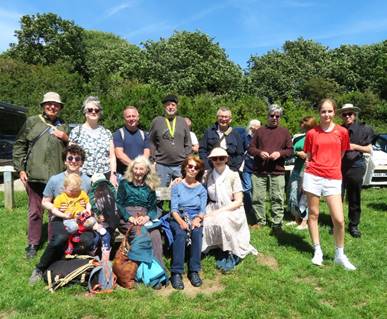
The session got off to a fine start with a buzzard (Buteo buteo) soaring over the woodland and one or more skylarks (Alauda arvensis) singing high in the sky. At the end of the afternoon, sweep-netting of the grassed areas was carried out using four large nets.
There were surprisingly few sightings of butterflies, possibly because of a persistent breeze, but satyrids were seen – speckled woods (Pararge aegeria), hedge browns (Pyronia tithonus) and meadow browns (Maniola jurtina) and small heaths (Coenonympha pamphilus). Two red admirals (Vanessa atalanta), one marbled white (Melanargia galathea) and one unidentified male blue were recorded. Hoverflies (Syrphidae) were well-represented, some on flowerheads.
Sweeping and catching by hand yielded a good variety of invertebrates including plant/leaf bugs (Miridae), meadow grasshoppers (Pseudochorthippus parallelus), ‘grass moths’ (mainly Chrysoteuchia culmella), and a nursery web spider (Pisaura mirabilis). The group collected several species of ladybird (Coccinellidae), one a (yellow) 22-spot (Psyllobora vigintiduopunctata) but, surprisingly, no harlequin ladybirds (Harmonia axyridis) were discovered.
Snail shells were found, mainly of the brown-lipped (Cepaea nemoralis), Molluscs, including the netted slug (Deroceras reticulatum), are common in the lower-lying damper areas, especially in the cooler months. A thorough malacological survey of the site is needed.
Plants were not neglected. A range of chalkland flowers was recorded and Valerie Jeffries (a member of the group who is an evolutionary biologist) spent time investigating apparent colour varieties of bramble (Rubus fruticosus) and (as yet unidentified) galls on their leaves, possibly caused by mites. Other invertebrate-associated plant lesions noted were tunnels of leaf miners, including many on holly caused by the dipteran Phytomyza ilicis .
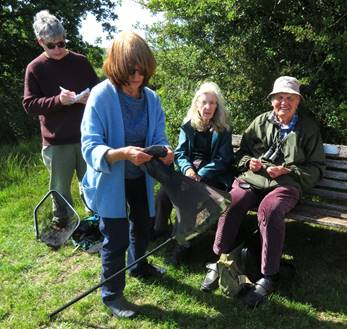
Live and dead invertebrates, plants and nibbled hazel nuts were collected and either identified in the field (photo below) or taken back to the Coopers’ home for identification later.
Even unpromising places in The Sanctuary yielded some species. The car park, for example, boasted its own chiffchaff (Phylloscopus collybita) which sang almost incessantly, apparently oblivious to the car-loads of people and dogs being loaded and unloaded only a few metres below it. As Maxwell Knight used to say “A good naturalist can find interesting things anywhere, even at a bus stop in London”.
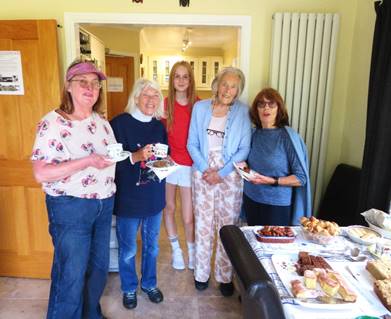
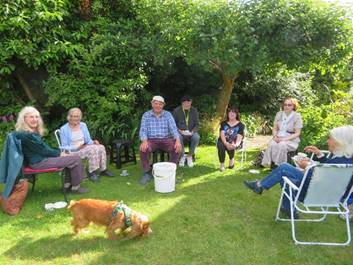
At the end of the afternoon attendees retreated to sit and talk in the Coopers’ garden, with regular sorties to the dining room, where (following several days of Margaret’s baking), there was an array of tea, cakes, sausage rolls and other delicacies (photo below).
The natural history theme, however, remained strong. Some of the afternoon’s finds were discussed and Hilda Cooper took round two smooth newts (Lissotriton vulgaris) to show the participants (photo below).
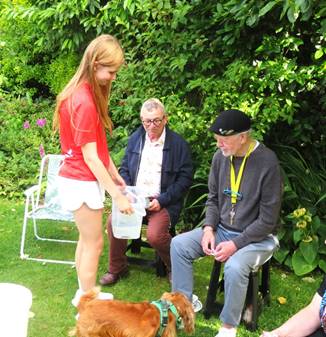
The afternoon closed with the release of 20-30 moths caught during the previous night in the Coopers’ moth trap (photo below). Most were “common” species, but good to see in this age of declining invertebrate populations and very educational for those attendees who were not knowledgeable about insects.
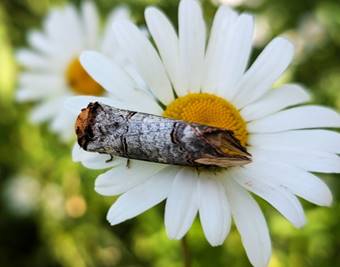
The group watched as yellow-underwings (Noctua pronuba) shot out of the trap with a flash of colour into the safety of bushes in the garden, enjoyed finding heart and dart (Agrotis exclamationis) moths still hiding under an eggbox in the bottom of the trap and were fascinated to be shown a buff tip (Phalera bucephala), immediately recognisable because it resembles a broken birch twig or an old-fashioned cigarette-end (photo below).
This event was very much in the mould of traditional natural history field meetings, which we associate with our own childhoods and those of our children. John fondly remembers going on many such trips in the late 1950s and 60s, most of them organised by the Camberley Natural History Society (CNHS) and led by Maxwell Knight.
The foray on the South Downs on Saturday 13th June appears to have been enjoyed by all and will, hopefully, have played a small part in helping to protect and conserve the appealing and important site known popularly as “The Sanctuary”.
Photos courtesy of the Coopers and Sue Holtom
………………………………………………..

